
Building A More Energy-Efficient Caribbean Through Regional Standards – CROSQ calls for increased national adoption of regional energy efficiency standards to advance affordability, resilience, and sustainable development
As CARICOM Member States confront persistently high energy costs, exposure to international fuel price volatility, and increasing climate-related pressures, the CARICOM Regional Organisation for Standards and Quality (CROSQ) is calling for increased national adoption of regional energy efficiency standards as a practical tool for strengthening economic resilience and supporting sustainable development.
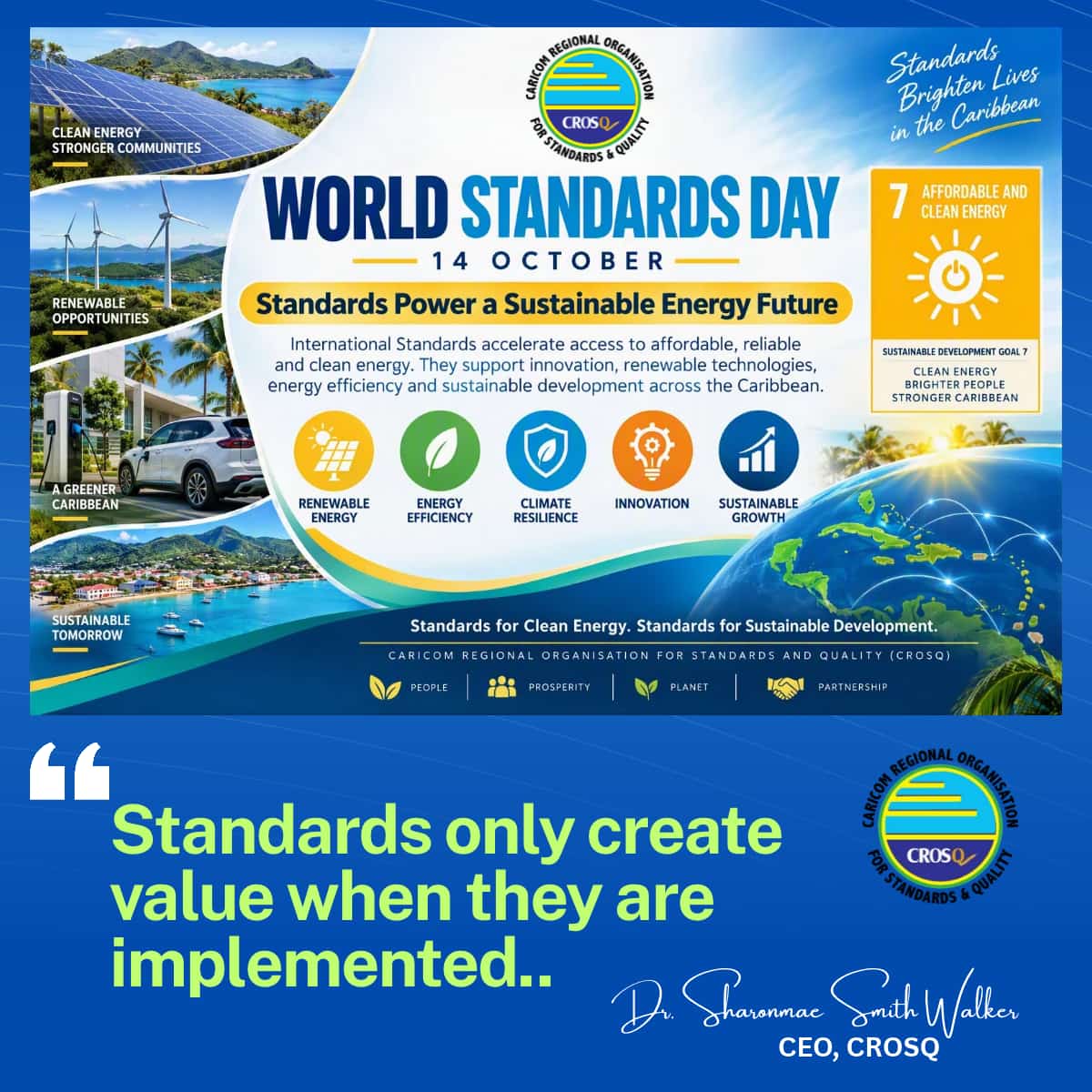
World Standards Day 2026, observed under the theme “Shared Vision for a Better World: Spotlight on SD7, Affordable and Clean Energy”, highlights the importance of Sustainable Development Goal 7 (SDG 7): Affordable and Clean Energy. For the Caribbean, achieving this goal requires more than expanding energy generation. It also requires reducing energy demand through more efficient buildings, appliances, technologies, and systems.
Over the past decade, CROSQ has worked with the CARICOM Secretariat, National Standards Bodies, and regional and international partners to establish a harmonised regional framework for energy efficiency. Following a mandate from CARICOM Energy Ministers in 2013, the organisation has led the development of a suite of regional standards designed to improve energy performance while supporting regional integration, economic competitiveness, and sustainable growth .
One of the Region’s most significant achievements is the CARICOM Regional Energy Efficiency Building Code (CREEBC), approved in 2018. Developed using internationally recognised International Code Council (ICC) and ASHRAE frameworks, the Code establishes minimum energy performance requirements for residential and commercial buildings, covering building envelopes, cooling systems, ventilation, lighting, pumping systems, and water heating. The Code, currently undergoing revision in alignment with the 2024 IECC, is in the final stages of review and approval, reflects evolving technologies, international best practices, and regional priorities.
CROSQ has also developed regional standards for the energy labelling of household refrigerators, air conditioners, compact fluorescent lamps (CFLs), and LED lighting, as well as for solar thermaltechnologies. Together, these standards provide governments, regulators, businesses, and consumers with a common framework for improving energy efficiency and supporting informed decision-making.
While significant progress has been made in developing regional standards, their full benefits can only be realised through wider national adoption and implementation.
According to Dr. Sharonmae Smith Walker, Chief Executive Officer of CROSQ:
“The Caribbean has already done the hard work of developing regional energy efficiency standards. The next step is adoption. Standards only create value when they are implemented, and greater uptake across Member States can help reduce energy demand, strengthen resilience, and deliver tangible benefits for Caribbean households and businesses.”
While the Caribbean has established a strong regional framework for energy efficiency standards, adoption across Member States remains uneven. Increasing uptake is critical if the Region is to realise the intended economic, environmental, and resilience benefits of this work.
To support this effort, CROSQ recently led the Promotion and Development of Harmonized Energy Standards in the Caribbean Region (CHESI), with support from the Inter-American Development Bank (IDB). The initiative assessed levels of adoption of existing regional energy efficiency standards, identified barriers to implementation, evaluated technical and institutional needs, and developed a practical roadmap that can support wider uptake across CARICOM Member States.
The initiative recognises that standards alone do not deliver results. Their impact depends on effective regulatory frameworks, adequate technical capacity, accessible testing and conformity assessment services, robust market surveillance, and sustained collaboration among governments, standards bodies, regulators, industry, and consumers.
As the Caribbean seeks to improve energy security, strengthen competitiveness, and build resilience to future shocks, energy efficiency offers an important pathway for governments, businesses, and consumers. The Caribbean has already established a framework of regional energy efficiency standards and supporting tools. Realising their full value now depends on increased national adoption, implementation, and sustained collaboration across the Region.
This World Standards Day, CROSQ renews its commitment to supporting Member States in translating regional standards into practical outcomes that advance affordability, resilience, competitiveness, and sustainable development across the Caribbean.